I will never forget that first dinner with my new dentures. I thought I had finally conquered my dental woes, but by the second bite of soft bread, I felt a sharp, stinging pinch that made my eyes water. It is a frustrating, visceral moment, isn’t it? You invest so much time and emotion into family dentistry solutions only to feel like your mouth is at war with a piece of plastic. That one hot spot—usually right on the ridge—can make you want to throw the whole set out the window. But here is the good news: that sore spot does not have to be your new reality. I have been exactly where you are, and I even made the rookie mistake of trying to ‘adjust’ the acrylic myself with a nail file (please, never do that!). Today, I want to share how to calm those gums and why your mouth is reacting this way so you can finally enjoy a meal again without the wince.
Get Instant Relief from the Rub
The first thing you need to realize is that your gums are essentially learning to walk in a pair of very hard, rigid shoes. When I first started my journey, I did not realize that even a tiny shift in my bite could create a major hotspot. You might even notice that your jaw feels tired because you are subconsciously tensing up to avoid the pain. The secret to soothing a sore spot is not just grit and determination; it is about active recovery. Warm salt water rinses are your best friend because they reduce inflammation and keep the area clean. Furthermore, ensuring you use the safest way to clean your dentures is critical, as any microscopic debris trapped under the plate acts like a pebble in a boot, grinding into your sensitive tissue.
Does This Pain Mean My Dentures are Broken?
It is the one fear that kept me up at night. I kept wondering if I had made the wrong choice or if I should have explored the difference between a dental bridge and a partial denture instead. But here is a surprising fact: according to the American College of Prosthodontists, almost every new denture wearer requires two to three professional adjustments in the first few months as the tissues settle. It does not mean your dentures are faulty; it means your mouth is a living, changing environment. Have you ever felt that sudden, sharp sting while trying to enjoy a simple lunch with friends? It is incredibly isolating, but you are not alone in this. Next, we are going to look at the ‘removal schedule’ that saved my sanity and my gums during those first few weeks.
Give Your Gums a Breathing Window
The biggest mistake most of us make is thinking we have to ‘tough it out’ and wear our dentures all day and night to get used to them. This is the fastest way to cause a localized infection. Your gums are not made of the same tough skin as the soles of your feet; they are delicate mucous membranes. Think of your new denture like a heavy backpack. If you never take it off, your shoulders will eventually blister. I remember attending my cousin’s wedding three weeks after getting my first set. By the time they were cutting the cake, my jaw was screaming. I actually had to sneak into a bathroom stall, pull them out, and hide them in my pocket for twenty minutes just to breathe. That tiny break allowed the blood flow to return to my gums, and I was able to finish the evening. This ‘recovery window’ is essential. If you feel a hot spot developing, take the dentures out for fifteen minutes every few hours. This prevents the pressure from turning a simple red mark into an open sore.
Identify the Friction Source Before Your Appointment
Before you head back to the clinic, you need to be a detective. Often, when you sit in the dental chair, the pain has subsided slightly, and it is hard to point exactly where the plastic is rubbing. You can use a ‘pressure test’ at home using a tiny bit of food-grade dye or even a smear of lipstick on the dry surface of your denture where you think the spot is. When you place it back in, the color will transfer to the exact spot on your gum that is being pinched. This helps your dentist make a precise adjustment rather than guessing. If you have noticed that why your gums are sore after getting a new dental crown feels like a similar sensation, it is usually because the fit is slightly ‘off-square,’ putting uneven weight on one side of the bone. 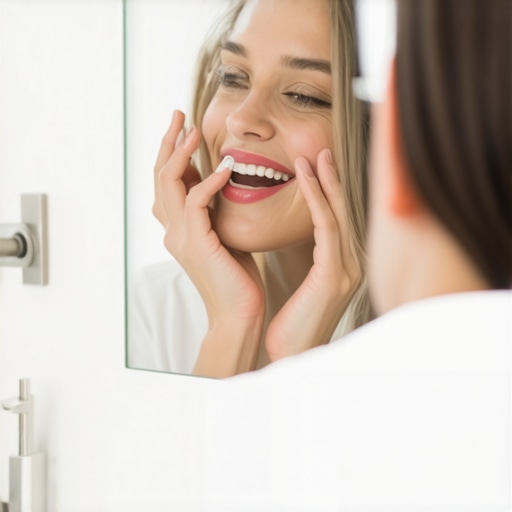
Why the Pain Peaks at Bedtime
Have you noticed that the throbbing gets worse the moment you hit the pillow? There is a physiological reason why your gums throb when you lay down at night. When you lie flat, blood pressure increases in your head and neck, which can make a minor irritation feel like a heartbeat in your jaw. To manage this, keep your head slightly elevated with an extra pillow and always soak your dentures overnight. This is non-negotiable. Your tissues need six to eight hours of complete rest to recover from the day’s friction. While your dentures soak, practice the best way to brush when you have sensitive gums using a soft-bristled brush to gently massage the ridges. This stimulates circulation and speeds up the toughening process.
Consider if a Permanent Solution Fits Your Lifestyle
Sometimes, no matter how many adjustments are made, the ridge of the jaw simply cannot support a traditional removable plate comfortably. This is common if you have significant bone loss. In these cases, it is worth looking into how dental implants reshape your oral health in 2025. Implants act like the roots of natural teeth, transferring the pressure of chewing into the bone rather than onto the surface of the gums. It is a major shift from the ‘floating’ feeling of dentures. If you are currently struggling with the discomfort of wires or plastic, learning how to manage mouth sores caused by orthodontic brackets can actually provide some relief techniques that apply here too, such as using dental wax on sharp acrylic edges as a temporary fix until you can get to the office.I have seen it dozens of times: someone spends thousands on a veneers transformation only to realize their smile looks fake or feels bulky. The most common myth in family dentistry circles is that cosmetic work is purely aesthetic. In reality, your bite—the way your upper and lower teeth meet—dictates everything. If you have a misaligned bite and try to mask it with porcelain, you are just creating a high-priced ticking time bomb. This is often why your veneers feel bulkier than your natural teeth; the dental lab is frequently forced to over-contour the material to compensate for an underlying structural issue that should have been addressed with orthodontics first.
Why Do My High-End Veneers Look Like Piano Keys in Flash Photography?
The Oops factor usually comes down to monolithic porcelain. Many patients walk in demanding the whitest shade possible, but as I discuss in my guide on the mistake that makes your teeth look too white and fake, real teeth are not one solid block of color. They are naturally translucent. A study published in the Journal of Esthetic and Restorative Dentistry highlights that the most successful restorations mimic the incisal halo—that slight transparency at the edge of the tooth that catches light. Without it, your teeth look like flat, white tiles under professional lighting.  This brings us to a crucial nuance: the emergence profile. When you are choosing between veneers vs. crowns, you must consider how the restoration exits the gum line. If the transition is not seamless, you will end up with black triangles or chronic gum inflammation. Before you commit to a full mouth reconstruction, ask about the reason your Culpeper dentist uses CBCT scans. These 3D images allow us to see the exact bone density around your roots, ensuring that how dental implants reshape your oral health is actually a viable path for your specific anatomy. If you skip this deep analysis, you risk the loose but fine paradox, which is why your dental implant feels loose but looks fine on the surface while failing at the bone level. Have you ever fallen into this trap of choosing shade over structure? Let me know in the comments.Once you have navigated the initial hurdles of fit and aesthetics, the real work begins: preservation. I used to think that because porcelain and titanium don’t decay, I could slack off on my hygiene. I was wrong. These materials are investments, and like any high-end machinery, they require specific tools and a rigorous schedule to function correctly. I personally swear by the ‘triple-threat’ approach: an ultrasonic cleaner for removable parts, a high-quality water flosser, and a custom-fitted occlusal guard. If you are struggling with a complex restoration, cosmetic dentistry secrets to boost your confidence often lie in how well you maintain the underlying gum health, not just the sparkle of the porcelain.
The Toolkit That Saved My Smile
If you have implants, you absolutely must use a water flosser. Traditional floss is great for natural teeth, but it can struggle to reach the nooks and crannies around an abutment. I found that the benefit of using a water flosser extends far beyond orthodontics; it flushes out bacteria from the peri-implant sulcus that a manual brush simply cannot touch. For those with veneers, I recommend switching to a non-abrasive gel toothpaste. Many ‘whitening’ pastes contain silica that can microscopically scratch the glaze of your porcelain, leading to premature dulling. Dr. Gordon Christensen of the Clinicians Report often emphasizes that the longevity of zirconia and porcelain is dictated by the management of ‘biofilm’—that sticky layer of bacteria we all fight daily. If you let it sit, you risk the very foundation of your work.
How do I maintain my dental restorations over time?
The secret is protecting the bite. I never go a night without my night guard. If you are a grinder, you can exert up to 250 pounds of pressure on your teeth while you sleep. That is enough to chip even the strongest veneer or loosen an implant over time. However, a dirty guard is a breeding ground for yeast. Learning how to clean your night guard without damaging the material is just as important as wearing it. I use a dedicated denture cleaner twice a week to ensure I’m not reintroducing bacteria into my mouth every night. #IMAGE_PLACE_HOLDER_D#
The Next Frontier of Digital Dentistry
Looking ahead, the industry is moving toward ‘biomimetic’ restorations. We are seeing a shift where the future of dental implants involves 3D-printed scaffolds that actually encourage your own bone to grow faster and stronger. We are also seeing AI-driven shade matching that eliminates the ‘piano key’ effect once and for all. In the next five years, expect to see dental implants 2025 innovations that use smart sensors to alert your phone if there is a change in the pressure or health of the surrounding tissue. This proactive technology will take the guesswork out of maintenance. If you want to stay ahead of the curve, I challenge you to try this one tip: start using an alkaline mouthrinse at night. It neutralizes the acidity in your mouth, which is the primary cause of the ‘sticky’ feeling and eventual staining around the edges of your veneers transformation. This small shift in pH can add years to the life of your smile.
What the Mirror Won’t Tell You About Your New Bite
The biggest hurdle isn’t the physical adjustment; it is the mental shift. You have to mourn your natural teeth a little bit while celebrating the freedom your new smile provides. One thing I wish I knew earlier is that perfection is the enemy of a natural look. If you are pursuing a veneers transformation, insist on some translucency at the edges; otherwise, they look like plastic tabs. Furthermore, your jaw muscles will feel like they have gone to the gym for the first few weeks as they adapt to the new vertical height of your teeth. Be patient—this is just your body recalibrating its neutral position.
The Daily Defense Kit I Actually Use
I don’t just rely on a standard toothbrush anymore. To protect my investment, I prioritize the benefit of using a water flosser because it reaches the microscopic gaps where implants meet the gum line. I also keep a strict schedule for cleaning my oral appliances; if you wear a retainer or guard, you must master how to clean your night guard without damaging the material to avoid chronic fungal infections. Finally, I always keep a small tin of dental wax in my bag—it is a lifesaver for those unexpected sharp moments before you can reach the office.
#IMAGE_PLACE_HOLDER_E#
Your Future Smile Is Worth the Growing Pains
Transitioning to dentures, implants, or veneers is a major life event. It requires a blend of modern technology and old-fashioned patience. While the road might have a few sore spots and adjustments along the way, the ability to laugh without covering your mouth or eat a meal without pain is a gift that keeps on giving. Whether you are just starting with family dentistry basics or looking into cosmetic dentistry secrets to boost your confidence, know that every adjustment brings you one step closer to a permanent state of comfort. Have you ever felt like your new dental work was more of a struggle than you expected? Let me know in the comments below!