I spent forty-five minutes last Tuesday staring into my bathroom mirror, poking my lower lip with a toothpick. I wasn’t looking for a piece of spinach; I was looking for a sign of life. After getting my second dental implant, the left side of my chin felt like a block of wood—completely detached from the rest of my face. It’s that pins-and-needles sensation that makes you wonder if you’ll ever feel the heat of a cup of coffee again. I’ve been through the ringer with dental implants, and let me tell you, that static feeling in your gums can be absolutely terrifying. Today, we are going to dive into why this happens, when you should actually worry, and how I finally got my sensation back.
That Weird Pins and Needles Feeling After Surgery
It is easy to think the worst when your mouth goes haywire. My big mistake early on was staying silent; I convinced myself that my body was just slow to wake up and ignored the tingling for two weeks, thinking it was just a quirk of family dentistry recovery. But here is the truth: while some numbness is totally expected due to local anesthesia and surgical trauma, a persistent buzzing or electric shock feeling usually has a specific culprit. Often, it is just local inflammation putting pressure on a nerve, but sometimes it means the implant is sitting a bit too close to the alveolar nerve. We are going to break down exactly why your jaw is acting like a radio tuned to static. Have you experienced this specific pins-and-needles sensation after a procedure?
Is this tingling actually worth the panic?
Most of us worry that a tingle in the chin means permanent nerve damage. I certainly did. However, clinical data suggests that temporary sensory changes occur in about 7% to 10% of implant cases, often resolving on their own as the tissue heals, according to the Journal of Oral Implantology. This isn’t just about the surgery itself; even 2025 innovations in comfort cannot entirely eliminate the way our individual nerves react to trauma. If you are feeling that vibrating sensation, it is often a sign that the nerve is actually trying to communicate through the swelling. It’s a lot like when your foot falls asleep and then starts to prickle as it wakes up.
When Your Gum Tissue Decides to Go Rogue
Sometimes the tingling isn’t about the nerve being hit, but rather how your body is handling the new hardware. If you had to get a bone graft before your implant, the extra volume in your jaw can create a crowded feeling. This pressure manifests as a buzzing or dull tingle. In my experience, the key is tracking whether the feeling is getting better or worse day by day. Some patients even report that their implant feels like it is vibrating when talking, which is usually a byproduct of how sound travels through the new titanium post. It is a bizarre sensation, but it is more common than your surgeon might have mentioned in the initial consult.Think of your alveolar nerve like a delicate copper wire running through a crowded construction zone. When your surgeon places the titanium post, that wire is naturally going to experience some static. To figure out if the wire is actually damaged or just temporarily pinched, you need to act as your own diagnostic technician. I remember the second night after my surgery; I was so convinced my chin was gone forever that I almost called the emergency line at 3 AM. Instead, I decided to run a controlled test.
Start with the ice cube test
Take a single ice cube or a frozen grape and gently press it against the area where you feel the pins and needles. Compare it to the opposite side of your face. If you can feel the cold—even if it feels dull or like a distant thud—the nerve is still communicating. In the world of cosmetic dentistry, this is a massive green flag. It means the pathway is open, but the ‘volume’ is just turned down due to inflammation. If you feel absolutely nothing, keep testing every few hours. Much like why porcelain veneers sometimes cause sensitivity to cold drinks, your nerves are simply in a state of high alert and need time to recalibrate their threshold. 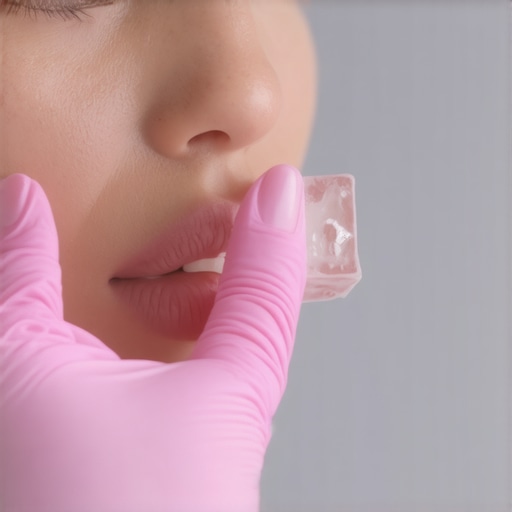
Monitor your sensory map every six hours
I grabbed a felt-tip marker and a mirror. Every six hours, I would gently poke my chin and lip to see exactly where the numbness ended. I actually drew a little faint line on my skin to see if the ‘dead zone’ was shrinking. This is the most objective way to track recovery. If that boundary moves even a millimeter toward the center of your chin over 24 hours, you are winning the battle.
Stop the swelling from crushing the nerve
Your primary goal during the first 72 hours is to give that nerve some breathing room. If the surrounding tissue is engorged with fluid, it acts like a heavy boot stepping on a garden hose. Keep your head elevated at a 45-degree angle—even while sleeping. This uses gravity to pull fluids away from the surgical site. I made the mistake of lying flat on my back the first day, and by evening, the implant felt like it was vibrating slightly, which was a clear sign the internal pressure was peaking. Managing this early on is just as crucial as knowing how long you should really wait to eat after an extraction to avoid disturbing the site.
Request a CBCT scan instead of a flat X-ray
If the tingling doesn’t improve within the first four days, you need better pictures. A standard 2D X-ray is like looking at a shadow on a wall; it can’t tell how close the implant is to the nerve in 3D space. There is a specific reason your dentist uses CBCT scans for these scenarios. It allows them to see the exact distance between the titanium and the nerve canal. If the post is too close, a simple ‘back-off’ procedure—where the dentist unscrews the implant by just a fraction of a millimeter—can instantly relieve the pressure and restore feeling. Don’t let a fear of ‘bothering’ the office stop you; when it comes to nerve health, the faster the pressure is removed, the better the long-term outcome.Identifying nerve proximity is only the first step in the complex dance between titanium and tissue. Most people assume that once they’ve paid for a high-end restoration, the biological work is finished. In reality, the ‘maintenance’ phase is where the real expertise is required. Many patients fall for the mistake that makes your teeth look too white and fake, thinking that a monochromatic porcelain slab equals beauty. But real veneers transformation requires what we call ‘micro-aesthetics’—mimicking the subtle translucency of natural enamel. If your new tooth looks like a piece of opaque tile, your dentist missed the nuance of light scattering.
Can a dental implant actually get sick?
A common myth is that because titanium can’t decay, you don’t have to worry about the future of your gums. While true that you won’t get a cavity, you are actually more vulnerable to a silent killer called peri-implantitis. According to the International Journal of Implant Dentistry, bone loss around an implant can happen twice as fast as around a natural tooth because the ‘attachment’ lacks the protective periodontal ligament. This is why you should take it seriously if your dental implant crown feels slightly wiggly when you bite. That wiggle isn’t just a loose part; it’s often a sign that the foundation is retreating.
Don’t let the ‘Set and Forget’ mentality ruin your investment
The biggest trap I see patients fall into is skipping their professional cleanings because ‘it’s just metal.’ Even with 2025 innovations that redefine comfort, your body is still in a constant state of negotiation with that post. If you notice a gray line at the gum or a faint metallic taste, your hygiene routine isn’t sufficient. Have you ever fallen into the trap of thinking your dental work was indestructible? Let me know in the comments. We need to talk about why how dental implants reshape your oral health depends entirely on how you treat them long after the tingling stops.
I learned the hard way that you cannot treat a six-thousand-dollar dental implant like a regular tooth. After my initial tingling subsided, I realized the real work was just beginning. If you think you can just breeze through your morning routine with a standard brush, you are asking for trouble. To keep my smile intact, I had to overhaul my bathroom counter with tools that specifically target the unique architecture of restorations. I’m talking about gear that gets into the tightest spaces, because the best way to remove a stubborn spinach leaf from under your bridge isn’t with a toothpick—it is with precision engineering.
My holy grail toolkit for titanium and porcelain
The first thing I bought was a high-end water flosser. I don’t use it on the highest setting; I keep it at a level four to gently pulse water into the ‘sulcus’—the little pocket where the gum meets the implant. I also swapped my standard floss for a specialized ‘bridge and implant’ spongy floss. Why? Because regular floss is too thin and often misses the plaque that accumulates on the underside of the titanium post. For my veneers transformation, I also invested in a non-abrasive gel toothpaste. Standard whitening pastes often contain silica, which can microscopic-scratch the glaze of your porcelain over time, making them lose that ‘wow’ factor. If you are also wearing protection at night, make sure you know how to clean your night guard without damaging the material, as a dirty guard is a breeding ground for the bacteria that cause gum inflammation around your new work.
How do I maintain my implants and veneers over time?
Maintenance isn’t just about what you do at home; it is about the technical specificity of your professional cleanings. I now specifically request ‘Airflow’ therapy during my hygiene appointments. This technology uses a fine spray of erythritol powder to remove biofilm without touching the surface of the implant with metal instruments. According to the International Team for Implantology (ITI), using traditional metal scalers on a titanium post can create microscopic grooves that actually attract more bacteria. You want your hygienist to be using plastic or carbon fiber tips to keep that surface perfectly smooth. This level of care is one of those cosmetic dentistry secrets to boost your confidence, knowing that your investment is being protected by the latest science. If you ever feel that something isn’t right, like why your dental implant crown feels slightly wiggly when you bite, you need to bring up these technical cleaning methods with your doctor immediately.
The digital future of your jawbone
Looking ahead, the way we track our dental health is shifting toward ‘digital twins.’ In the next few years, I expect we will all have 3D digital models of our mouths stored in the cloud. Instead of comparing a new X-ray to an old one, your dentist will use AI to overlay your current scan with your ‘baseline’ to detect bone loss or shifting of a millimeter or less. This is where how dental implants reshape your oral health in 2025 becomes a reality—it’s no longer about reactive care, but predictive monitoring. I highly recommend that you ask your dentist for a copy of your most recent scan today so you have your own baseline. My advanced tip for you this week: start using the ‘water flosser first’ method before you brush. It loosens the heavy debris so your fluoride toothpaste can actually reach the gum line of your implants and veneers more effectively.
The Hard Truths About Living with Nerve Static
I wish someone had told me that the mental game is just as tough as the physical recovery. That tingling isn’t just a symptom; it’s a constant reminder that you’ve undergone a major change. Looking back, I realized that my anxiety peaked when I felt I had no control, which is why the mapping exercise I mentioned earlier was so vital. If you find yourself in the same boat, remember that nerves are incredibly slow learners—they heal at a glacial pace, but they do heal. Staying proactive with family dentistry check-ups ensures that any minor pressure is caught before it becomes a permanent issue.
Another lightbulb moment for me was realizing that every person’s anatomy is a unique map. What worked for my neighbor’s implant didn’t necessarily apply to mine. I had to learn to trust my own data over generic internet forums. If the tingling persists, it’s not a failure on your part or the surgeon’s; it’s just the future of dental implants meeting the reality of human biology. Your job is to be the best advocate for your own comfort.
#IMAGE_PLACE_HOLDER_E#
Gear That Actually Protects Your Titanium Investment
Maintaining the area around a tingling nerve requires a gentle touch and specialized tools. I personally swear by these three items: First, a high-quality water flosser is non-negotiable for cleaning the sulcus without the physical scraping of traditional tools. Second, I found that an ultra-soft surgical toothbrush helped me keep the site clean without triggering that electric shock feeling. Finally, using a pH-balanced mouthwash prevented the dry mouth that often accompanies post-surgical nerve sensitivity. These steps are part of the cosmetic dentistry secrets to boost your confidence while you wait for full sensation to return.
Your Road to a Sensation-Filled Smile
The journey from pins and needles to a fully functional, natural-feeling smile is rarely a straight line. It’s a process of tiny victories, like the first time you feel the coldness of a glass of water on your lip again. Don’t let the temporary static discourage you from the incredible benefits of how dental implants reshape your oral health. If you ever feel like you’re stuck or the progress has stalled, reach out to a professional immediately to discuss your concerns. You’ve invested too much in your smile to settle for anything less than total comfort. If you have any lingering doubts about your recovery, don’t hesitate to contact us for a professional evaluation. Have you ever experienced a lingering tingle or buzz after a dental procedure, and how long did it take to fade? Let me know your experience in the comments below!