I remember sitting in my car after the numbing finally wore off, staring into the rearview mirror and trying to smile. On the outside, everything looked like a magazine cover. But on the inside? It felt like I had a mouthful of piano keys. My tongue, which is surprisingly sensitive to even the smallest changes, was on a frantic mission to map out these new, strangely thick borders. I felt like I couldn’t quite close my lips naturally without thinking about it. If you are currently running your tongue over your teeth and wondering if you made a massive mistake, I want you to take a deep breath. I have been exactly where you are.
That Moment My New Smile Felt Like a Mouth Guard
When I first started my veneers transformation, I envisioned getting those perfectly thin, shell-like covers that would feel invisible. However, reality hit me hard during that first week. I made a classic mistake: I didn’t realize that even ‘thin’ porcelain adds a physical layer to your dental structure. According to the American Academy of Cosmetic Dentistry (AACD), traditional veneers usually range from 0.5mm to 0.7mm in thickness, but even a 0.3mm change can feel like a mountain to your mouth’s proprioception. I spent the first three days convinced I looked like a cartoon character, even though my friends insisted I looked great. I was so worried about the size that I almost missed how much better they looked than my old, chipped teeth. If you find that your porcelain veneers look opaque or feel physically heavy, it’s often a mix of your brain adjusting and the actual technical prep of the tooth.
Is this bulky feeling actually permanent or just in my head?
It is the question that kept me up at night. I kept thinking, ‘Is this just my life now? Am I going to lisp forever?’ The truth is, your brain is incredibly good at adapting, but there is a limit. Early on, I didn’t advocate for myself enough during the temporary phase. I assumed the ‘bulk’ was just part of the deal. I’ve since learned that following expert tips for perfect results means being vocal about how your bite feels from day one. Your tongue is the ultimate snitch; it will find every ledge and every extra millimeter of porcelain. Today, we are going to dive into why this happens, when it’s a sign of a bad fit, and when it’s just your ‘internal map’ needing a software update. Have you ever felt like your new teeth were taking up too much room in your mouth? I’d love to hear your story in the comments. Let’s look at what is actually going on behind that new porcelain.The first step to losing that “horse teeth” sensation is recognizing that your mouth is the most sensitive real estate on your body. Your brain has spent decades mapping your teeth to the micrometer, and any change is treated as an intruder. In the world of cosmetic dentistry secrets to boost your confidence, we call this the adaptation phase, but there are concrete things you can do to speed it up.
Give your brain a week to update its map
Your tongue is essentially a high-precision scanner that constantly monitors your oral environment. When it encounters a new porcelain surface, it alerts your brain that something is wrong. To combat this, you need to force your brain to accept the new dimensions. Practice reading a book aloud for twenty minutes a day. Focus specifically on your “S,” “T,” and “V” sounds. If you have ever wondered why your clear aligners are making you lisp even after a week, the cause is the same: your tongue is fighting for space. By speaking intentionally, you teach your tongue where the new boundaries lie, and within a few days, the brain begins to ‘filter out’ the sensation of the extra porcelain.
Isolate the physical interference
It is vital to distinguish between a mental adjustment and a mechanical error. If you feel like your jaw is constantly clenched or your teeth don’t meet comfortably, the issue is likely your bite, not your brain. I remember on my fourth day with my new smile, I sat down to eat a simple ham sandwich and felt a sharp, jarring pressure on my front left tooth. I realized my jaw wasn’t closing in its natural path. I went back to my dentist and insisted on a bite adjustment. We discovered the porcelain was just 0.4mm too thick on the lingual (back) side. Once he polished that tiny fraction away, the “bulky” feeling vanished in minutes. 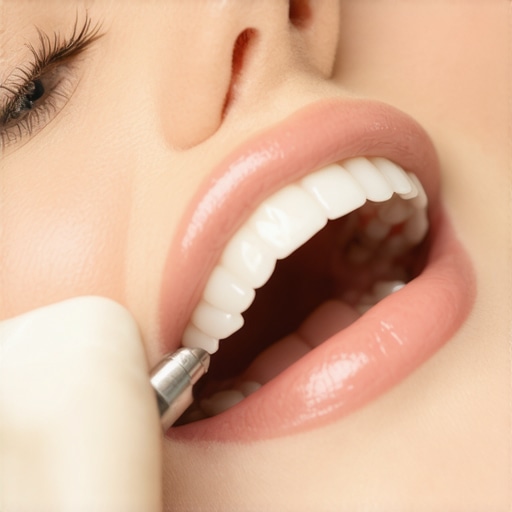
The simple test for speech and clearance
A quick way to check for over-bulking is the “F” and “V” test. Stand in front of a mirror and say words like “five” or “victory.” Your upper veneer edges should lightly touch the wet-dry line of your lower lip. If they feel like they are crashing into your lip or pushing it outward, the veneers may be too long or too thick at the edge. If the reason your porcelain veneer feels rough to your tongue is accompanied by this lip-catching sensation, you are dealing with a design issue that needs a professional touch-up.
Differentiate between a bad fit and a bad habit
Sometimes the bulkiness comes from the transition from thin, natural enamel to porcelain. If you moved from severely worn-down teeth to full-sized veneers, the new length is actually what your teeth *should* have been all along. However, if the dentist didn’t remove enough natural tooth structure during the prep phase, the porcelain sits on top like a cap, creating a “shelf” at the gumline. This is often the same technical oversight that leads to the mistake that makes your teeth look too white and fake. If you can feel a ledge where the veneer meets your gum with your fingernail, that is a physical bulk that can lead to plaque buildup and should be smoothed down.
Demand a bite check if your jaw feels tired
If you wake up with a sore jaw or a headache, the thickness of your veneers is likely interfering with your centric relation—the way your jaw hinges. You should not have to “find” a comfortable place to rest your teeth. In some cases, choosing veneers vs crowns means the dentist has less room to work with, and the resulting porcelain can be slightly more prominent. Don’t be afraid to ask for a T-Scan or articulating paper test to ensure your pressure is distributed evenly across all your teeth.
One of the biggest misconceptions I see people post about online is the idea that ‘no-prep’ or ‘minimal prep’ veneers are always the superior choice because they preserve more enamel. I used to believe this too, thinking that the less the dentist touched my natural teeth, the better. However, this is exactly where the ‘horse teeth’ trap begins. If a dentist places porcelain over a tooth that hasn’t been properly contoured, they are essentially adding a second story to a house without adjusting the foundation. The result is a tooth that protrudes too far forward, interfering with your lip posture and creating that dreaded bulky sensation.
Why No-Prep Veneers Often Cause the Very Problems You Are Trying to Avoid
In my experience, the quest for ‘conservative’ dentistry often leads to over-contoured restorations. When there is no room for the porcelain to sit ‘in’ the tooth, it must sit ‘on’ the tooth. This is a primary reason why your porcelain veneers look opaque and not natural; they simply don’t have the depth needed to mimic the translucency of real enamel. A study in the Journal of Prosthetic Dentistry emphasizes that improper emergence profiles—the angle at which the tooth exits the gum—can lead to chronic gingival inflammation. If your veneers feel like they have a ‘ledge’ at the gumline, it’s not just a comfort issue; it’s a health risk. This is a nuance often missed when people are comparing veneers vs crowns during their initial consultations.
The ‘Oops’ factor here is assuming that ‘thin’ equals ‘comfortable.’ In reality, comfort comes from the harmony of the bite and the transition at the gingival margin. If your dentist doesn’t account for ‘biological width’—the specific amount of space your gum tissue needs to stay healthy—you will face permanent redness and swelling regardless of how white your teeth are. This is why family dentistry tips for a lifetime of healthy smiles always prioritize gum health over aesthetics.
Can the placement of my veneers affect my long-term jaw health?
Absolutely. If your veneers are even a fraction of a millimeter too thick on the biting surface, they can trigger a condition called bruxism (grinding). Your brain senses the ‘high spot’ and tries to grind it down subconsciously. This is a sophisticated mistake that many high-volume cosmetic shops overlook. I’ve seen patients who sought out cosmetic dentistry secrets to boost your confidence only to end up with chronic TMJ pain because their new smile was functionally incompatible with their jaw’s natural movement. This is a similar technical challenge found in the future of dental implants and cutting-edge techniques in cosmetic dentistry, where precision is more important than the material itself.
Have you ever fallen into this trap of choosing the ‘least invasive’ option only to realize it felt physically overwhelming later? Let me know in the comments. We need to stop equating ‘no-prep’ with ‘no-problems,’ because sometimes a little preparation is the only way to achieve a smile that actually feels like it belongs to you.
Once you get past that initial ‘piano key’ sensation, the focus shifts from survival to preservation. I quickly realized that the biggest threat to my new smile wasn’t a hard apple or a stray piece of candy; it was my own jaw. If you are someone who clenches when stressed, you are essentially putting a hydraulic press against your porcelain every night.
Stop the Nighttime Grinding Before It Cracks Your Porcelain
To protect my investment, I had to get serious about occlusal guards. I’m not talking about those soft, squishy ones you find at a drugstore; those can actually encourage your jaw to chew more. I use a custom-fabricated, hard-acrylic 2mm night guard that keeps my teeth in a neutral position. According to Dr. Gordon Christensen, a leading authority in restorative dentistry, the primary cause of cosmetic failure in the first five years is the lack of a proper night guard for patients with even mild bruxism. Without this barrier, you risk a catastrophic fracture that leads to the frantic search for what to do when a veneer pops off during dinner. It is also vital to learn how to clean your night guard without damaging the material, as bacteria buildup can lead to gum irritation around the margins of your porcelain. 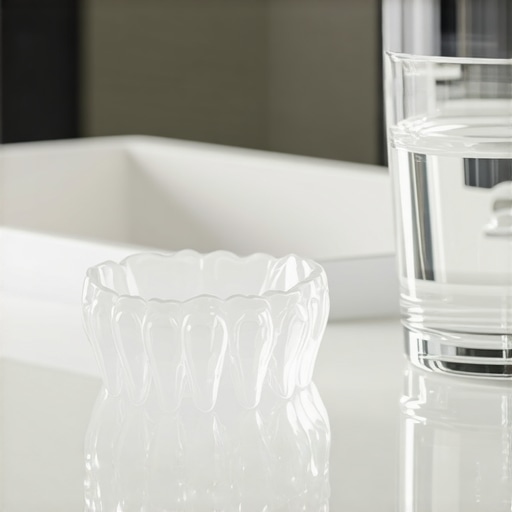
How do I make sure these veneers last more than a decade?
The secret isn’t in the dentist’s office; it’s in your bathroom cabinet. I’ve adopted a ‘low-abrasion’ lifestyle. Traditional whitening toothpastes are often too gritty, essentially acting like sandpaper on your polish over time. I switched to a gel-based, non-abrasive formula and paired it with an electric toothbrush that has a pressure sensor. If the light turns red, I’m pressing too hard and risking the very gum recession I was trying to hide. This is one of the essential family dentistry tips for a lifetime of healthy smiles that applies whether you have natural teeth or a full set of porcelain. I also expect that by the time we hit 2030, we will see ‘smart’ veneers equipped with micro-sensors that alert your phone if your bite pressure is becoming uneven.
Why I Swapped Standard Floss for a High-Pressure Water System
Because veneers and bridges are often placed so closely together, traditional string can be a nightmare to navigate. I found that the secret to flossing when your teeth are tightly crowded is utilizing a high-quality water flosser. I personally use the Waterpik Aquarius on a setting of 5. It provides enough force to clear the ‘sulcus’—that tiny pocket where the porcelain meets the gum—without being so aggressive that it causes trauma. This is especially important as we look at how dental implants reshape your oral health in 2025, where tissue health is the cornerstone of longevity. My challenge to you: Tonight, set your water flosser to a medium setting and focus exclusively on the 45-degree angle where your veneer meets the gumline; you will be shocked at the debris your manual brush has been leaving behind.
Hard Truths I Discovered While Living with My New Teeth
After navigating the first few weeks, I realized that the temporary phase is the most critical time for feedback. If you do not speak up then, you will be fighting the ‘bulk’ later. Another lesson? Your brain’s ‘proprioception’—its sense of where your teeth are—is more powerful than any mirror; if it feels wrong, it is wrong for you, regardless of how it looks in photos.
I also learned that less isn’t always more. Sometimes a tiny bit of extra prep is better than a bulky no-prep result that makes your lips feel stretched. Finally, trust the process but verify the bite. A millimeter is a mountain in your mouth, and you deserve a fit that feels effortless.
Gear That Kept My Smile Healthy and Comfortable
To keep my results looking great, I rely on a few specific tools. First, a high-quality water flosser is non-negotiable, especially since the secret to flossing when your teeth are tightly crowded often involves more than just string. I also religiously use a custom night guard. If you have one, make sure you know how to clean your night guard without damaging the material to avoid staining your porcelain margins. #IMAGE_PLACE_HOLDER_E# Lastly, I keep a log of my bite sensitivity to discuss during my biannual checkups, following standard family dentistry tips for a lifetime of healthy smiles.
Embrace the Confidence You Deserve
Your journey doesn’t end the day the porcelain is bonded. It is an ongoing relationship with your oral health. A successful veneers transformation is about more than just white teeth; it is about a smile that functions in harmony with your life. Don’t be afraid to ask for adjustments until it feels like ‘you.’ You have invested in yourself, so make sure that investment brings you joy every time you look in the mirror. With these cosmetic dentistry secrets to boost your confidence, you are well on your way to a comfortable, stunning smile.
Have you ever felt like your dental work was just a tiny bit too big for your mouth? Let me know your experience in the comments below!