I will never forget the sinking feeling in my gut when my five-year-old nephew looked me dead in the eye and asked, “Why does your mouth smell like a trash can?” I had just finished my morning routine—two minutes with a vibrating brush, a thorough flossing session, and a gargle that felt like it was stripping my soul. I was devastated. I had followed every rule in the book, yet there I was, a walking biological hazard. I realized then that I was making a massive mistake: I was focusing only on the surfaces I could see and completely ignoring the biological ecosystem thriving in the dark corners of my mouth. It is visceral, it is embarrassing, and honestly, it is more common than you think.
The Routine That Failed Me and Probably You Too
It is incredibly frustrating when you are doing the work but not getting the results. You buy the expensive toothpaste, you follow family dentistry tips for a lifetime of healthy smiles, and yet that stale, sour taste returns before you have even finished your first cup of coffee. I spent years thinking I just needed to brush harder, which actually led to me wondering why your gums are receding even though you brush twice a day. The truth is, chronic halitosis often has nothing to do with how hard you scrub and everything to do with what you are missing. Today, we are going to dive into the uncomfortable truth about why your breath still smells. We are going to look past the minty facade and address the un-brushable areas, from the back of your tongue to the gaps in your restorations. Have you ever felt like you were fighting a losing battle with your breath despite your best efforts?
Is this just a scam to sell more dental gadgets?
I get it. You are skeptical. You have seen the ads for tongue scrapers, special probiotics, and high-tech water flossers. It feels like another way to drain your wallet. But according to a study published in the Journal of Natural Science, Biology and Medicine, nearly 90% of bad breath originates in the mouth, often from the tongue surface where bacteria produce volatile sulfur compounds (VSCs). This isn’t about buying more stuff; it is about changing your strategy and understanding the biology of your mouth.
Hidden Pockets and Old Work That Stinks
One thing I learned the hard way is that old dental work can be a magnet for odor-causing bacteria. I once had a crown that looked fine but was actually a motel for microscopic food particles. If you have older work, you might need to know how to tell if your dental bridge is trapped with food you can’t see. It is not just about the teeth; it is about the environment. Sometimes, even the best cosmetic dentistry secrets to boost your confidence involve replacing aging materials that have become porous over time. We will explore how to identify these traps before they ruin your social life.
Your tongue is a shag carpet for bacteria
Think of your tongue not as a flat surface, but as a deep-pile shag carpet. It is covered in thousands of tiny bumps called papillae, which create a massive surface area for food particles and dead cells to hide. When bacteria break these down, they release volatile sulfur compounds—the literal chemical name for ‘trash can breath.’ Brushing your tongue with a toothbrush is like trying to sweep a carpet with a rake; you might move the dirt around, but you aren’t getting it out of the fibers. I remember the first time I used a professional-grade stainless steel scraper. I gagged twice, but the sheer amount of grey, opaque sludge that came off was a wake-up call. My mouth felt lighter instantly, and that stale morning taste vanished for the first time in years. 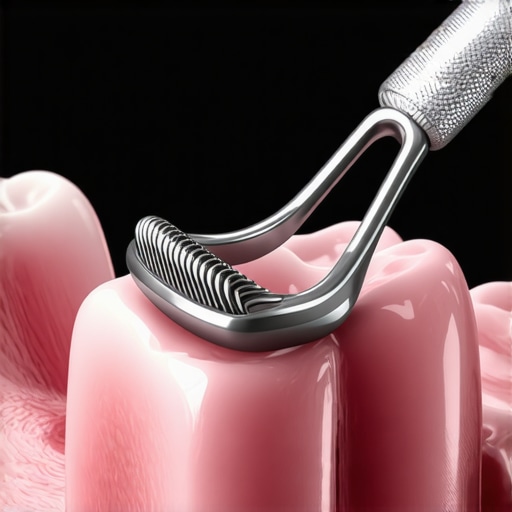
Get a dedicated tool for the job
If you are serious about this, stop using your toothbrush on your tongue. The bristles are designed for hard enamel, not soft tissue. A metal or high-quality plastic scraper allows you to apply even pressure from the back of the tongue toward the front, physically lifting the biofilm out of your mouth. If you find yourself gagging, try exhaling forcefully as you scrape; it suppresses the reflex. This simple thirty-second addition to your routine does more for your breath than an hour of aggressive scrubbing ever could.
Clean the spaces your toothbrush physically cannot reach
We often think of our teeth as individual pillars, but they are more like a series of interconnected tunnels, especially if you have had any restorative work. If you have a bridge, you are essentially trying to clean the floor under a piece of low-clearance furniture. It is incredibly easy to miss debris, which is why you need to know how to tell if your dental bridge is trapped with food you can’t see. When food sits in these dark, oxygen-deprived pockets, it ferments. That fermentation is what causes that sharp, localized odor that no amount of peppermint gum can mask. For those with complex work, you must learn how to clean under a dental bridge without shedding your floss to maintain a neutral-smelling environment.
Watch out for bulky restorations
Sometimes the problem isn’t your cleaning technique; it is the dental work itself. If your crowns or veneers don’t fit perfectly against the gum line, they create a ‘shelf’ where bacteria thrive. I once saw a patient who complained of a constant metallic taste and bad breath, only to realize their new work was trapping everything. If you find that why your veneers feel thick and bulky when you try to say the letter s is a concern you share, it might be a sign that the restoration is making it impossible to stay clean.
Don’t let dry mouth turn your saliva into glue
Saliva is your mouth’s natural detergent. It neutralizes acids and washes away debris. When your mouth dries out, your saliva thickens and becomes sticky, losing its ability to clean. This is why your mouth feels sticky and dry when you wake up, and why ‘morning breath’ is so potent. If you are a mouth-breather at night or if you are dehydrated, you are essentially leaving your mouth without its primary defense system. Beyond just drinking water, you need to ensure your oral microbiome is balanced. There is a surprising connection between your gut health and your bleeding gums that can also affect the scent of your breath. If your gut is out of whack, the gas produced during digestion can actually be exhaled through your lungs and mouth.
Don’t Treat Your Veneers Like Bulletproof Glass
One of the biggest myths I encounter is the idea that cosmetic dentistry is a ‘set it and forget it’ solution. Patients often assume that because porcelain doesn’t decay, they can slack on their hygiene. This is a massive mistake. While the veneer itself won’t get a cavity, the tiny sliver of natural tooth at the margin is more vulnerable than ever. If you don’t follow expert tips for perfect results, you risk ‘leakage,’ where bacteria seep under the restoration. This creates a localized scent that no mouthwash can reach. Even the most high-end work requires vigilance to prevent the underlying structure from failing. If you have noticed a change in the surface of your work, you may even need to learn how to polish a scratched veneer at home without damaging the protective glaze.
The Invisible Failure of High-End Restorations
Many people focus on the color, but the texture is what determines if a smile looks real or like a row of bathroom tiles. If you’re wondering why your veneers look like white chiclets, it’s usually because the laboratory didn’t add enough surface anatomy. These flat surfaces don’t just look fake; they fail to deflect food and saliva as effectively as natural, contoured teeth, leading to a buildup of biofilm in areas you wouldn’t expect. I always tell my patients that the secrets to making your porcelain veneers last twenty years involve more than just avoiding hard candy; it’s about maintaining the health of the gingival margin. #IMAGE_PLACE_HOLDER_C#
Is your dental implant actually vibrating or is it just your imagination?
For those who have moved past traditional restorations to implants, a new set of nuances arises. You might find yourself searching for the reason your dental implant feels like its vibrating or oscillating. Often, this isn’t a mechanical failure but a sign of how your jawbone is integrating with the titanium. However, the advanced ‘trap’ here is ignoring a subtle, persistent odor. A study in the Journal of Oral Implantology highlights that titanium implants are highly susceptible to peri-implantitis if biofilm isn’t managed. Because there are no nerves in the implant itself, you won’t feel the ‘warning pain’ of a cavity. By the time you notice a smell, the bone loss might already be significant. This is the real cost of skipping your six month checkup; you lose your early warning system. Have you ever fallen into this trap? Let me know in the comments.
The specific tools I use to protect my investment
I didn’t spend thousands on a new smile just to watch it crumble because of a $5 mistake. Most people think a standard toothbrush is enough, but once you have advanced restorations, you are playing a different game. Personally, I swore off traditional string floss for my implants. It’s too easy to shred or leave fibers behind that irritate the tissue. Instead, I transitioned to a high-pressure water flosser—specifically a model with a specialized ‘Plaque Seeker’ tip. This isn’t just about convenience; it’s about mechanical efficiency. According to the International Journal of Periodontics & Restorative Dentistry, plastic-coated interdental brushes are the gold standard for cleaning titanium abutments because they won’t scratch the surface, which prevents new bacteria from hitching a ride on microscopic grooves. I carry a pack of TePe brushes in my bag like they are emergency rations. If you want to know the 3 secrets to making your porcelain veneers last twenty years, it starts with treating the margins of your teeth with the same precision a jeweler uses on a diamond.
How do I maintain my dental implants and veneers over time?
Maintenance is less about the strength of your scrub and more about the chemistry of your mouth. I switched to a non-abrasive, low-RDA (Relative Dentin Abrasivity) toothpaste. Many whitening pastes are essentially liquid sandpaper; they will strip the polish off your porcelain, leaving it dull and prone to staining. Beyond the tools, you have to look at your mechanical habits. If you are a grinder, skipping your night guard for even a weekend is a gamble you will eventually lose. This is one of the expert tips for perfect results that most patients ignore until they see a crack. I also suggest using a pH-balancing mouth rinse. A neutral environment prevents the ‘sticky’ feeling and protects the natural tooth structure still hiding under your work. If you are struggling with a bridge specifically, learning how to clean under a dental bridge without shredding your floss is the single best way to avoid the dreaded ‘metallic’ taste of trapped bacteria. #IMAGE_PLACE_HOLDER_D#
Where the technology of your smile is headed
We are entering an era where your dental work will be smarter than your phone. I predict that within the next five years, we will see ‘smart implants’ equipped with biosensors that can alert your dentist to inflammation before you ever feel a throb or see redness. We are already seeing how how dental implants reshape your oral health in 2025 through 3D-printed bone scaffolds and faster osseointegration. The goal is no longer just replacing a tooth; it’s about integrating a permanent, biological-mechanical hybrid that functions better than the original. This shift toward longevity means that cosmetic dentistry secrets to boost your confidence will soon include preventative AI monitoring as part of your standard checkup. I’m already seeing patients who use apps to track their oral microbiome, and the results are staggering. The key is to stay proactive. My challenge to you: stop by a pharmacy today and pick up a pack of interdental brushes sized specifically for your gaps. Use them just once tonight, and I promise you will be shocked at what your ‘perfect’ brushing routine left behind.
The Hardest Lesson I Learned About Protecting My High-End Dental Work
After years of trial and error, I realized that the biggest threat to my confidence wasn’t the food I ate, but the gaps I ignored. First, the ‘porcelain shield’ is a myth. While the material doesn’t rot, the margins where it meets your gum are the most vulnerable spots in your mouth. If you are experiencing a persistent metallic taste after dental surgery, it’s often your body’s way of saying bacteria have found a new home. Second, I learned that a fresh smell is the result of a balanced ecosystem, not just masking odors. If you understand how all-on-4 implants feel in your mouth, you know that keeping that space healthy requires a different level of vigilance than natural teeth. Finally, don’t wait for pain to take action. In the world of high-end restorations, odor usually precedes physical discomfort by months.
The Minimalist Kit That Actually Saved My Social Life
I stopped buying every ‘miracle’ mouthwash and narrowed it down to four non-negotiable tools. A stainless steel tongue scraper is my number one recommendation; it’s more hygienic than plastic and removes the biofilm that brushes simply cannot lift. I also rely on a high-pressure water flosser to reach under the pontics of my bridges where standard floss would just shred. For those who have undergone a veneers transformation to unlock their best smile, using a low-RDA (Relative Dentin Abrasivity) toothpaste is essential to keep the surface smooth and stain-resistant. Lastly, I keep a supply of plastic-coated interdental brushes. These are the gold standard because they don’t scratch titanium components, which is vital for maintaining the longevity of your investment.
Reclaim Your Confidence One Scrape at a Time
You’ve put in the work, and you’ve likely invested significantly in your oral health. Don’t let a lingering scent hold you back from living your life fully. Whether you are curious about the future of dental implants and cutting-edge techniques or you are just trying to get through a morning meeting without feeling self-conscious, remember that you are in control of your oral microbiome. Small, precise changes to your daily routine can transform your breath from a source of anxiety into a sign of vibrant health. If you have any concerns about your restorations or need a professional assessment, don’t hesitate to contact us for a consultation. You deserve to smile without reservation.
Have you ever noticed a strange scent coming specifically from one piece of dental work? Let me know in the comments below!