I will never forget the moment I looked in my bathroom mirror, pulled back my upper lip to inspect what I thought was a stubborn piece of spinach, and felt my heart sink into my stomach. It wasn’t food. There, right at the margin of my gumline, was a tiny, unmistakable speck of dark, metallic grey. My dental implant screw was peeking through. Panic immediately set in. I kept thinking, Is my entire implant failing? Am I going to lose my front tooth?
If you are staring at a similar metallic glint in your mouth right now, please take a deep breath. You are not alone, and your smile is not ruined. Today, we are going to dive into exactly why this happens, when you need to call your dentist, and how we can get your smile looking seamless again using modern cosmetic dentistry solutions.
That Cold Panic When Metal Peeks Through Your Gums
When I first noticed that tiny speck of grey, my immediate reaction was to scrub it. I grabbed my toothbrush and brushed so hard my gums started bleeding. That was my first major mistake. I thought I could clean it away, but in reality, aggressive scrubbing only worsens the issue by wearing down the delicate tissue even further. If your tissue is thin, rough brushing accelerates recession, making more of the metal visible.
According to clinical studies on implantology, minor mucosal recession affects a surprising number of patients over time due to thin tissue biotypes or natural bone remodeling. It is a common physical progression, not a personal failure of hygiene. The metal you see is usually the implant abutment or the top of the fixture itself, becoming visible because the overlying pink tissue has thinned out or pulled back.
Is this showing screw actually a dental emergency?
Your mind might be racing with worst-case scenarios, but a visible screw is rarely an immediate emergency unless it is accompanied by severe pain, swelling, or a distinct wobbling sensation. If your implant feels rock solid, you have time to plan your next step. However, it is not something to ignore. Leaving the metal exposed to the bacteria in your mouth can eventually lead to peri-implantitis, a form of gum disease that attacks the bone supporting your implant.
We need to address this before it compromises the structural integrity of your implant. Fortunately, whether you need minor tissue grafting, a crown replacement, or a custom abutment, there are highly effective ways to restore both the health and aesthetics of your smile. Have you noticed a shadow or a bit of grey metal showing near your gumline recently? Let me know in the comments below, or reach out to a professional to check it out.
Your Step-by-Step Action Plan to Conceal and Correct Exposed Metal
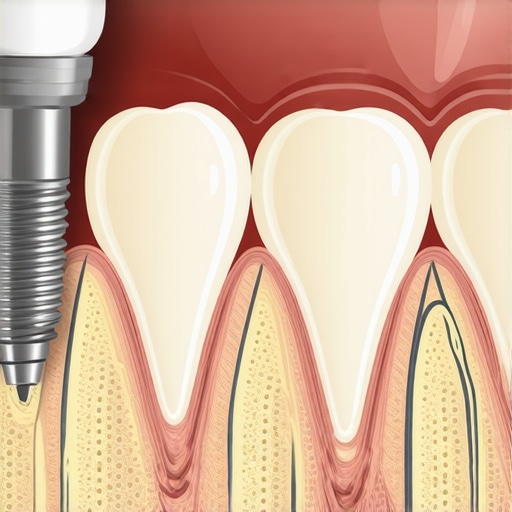
When you see that grey speck, you cannot just wish it away. Your dental implant is essentially a three-part machine: the titanium post buried in your bone, the crown that looks like a tooth, and the connector abutment in the middle. Think of your gums like a protective turtleneck sweater. If the collar of that sweater stretches out or pulls down, the neck underneath becomes visible. To fix this, we have to either adjust the ‘collar’ or change the color of the ‘neck’.
When I panicked over my own gray spot, my dentist walked me through three distinct clinical options. The exact path forward depends entirely on whether your tissue is healthy but thin, or if you have actually lost supportive bone structure. Here is how modern dentistry solves the problem without starting over from scratch.
The Abutment Swap for Instant Aesthetic Relief
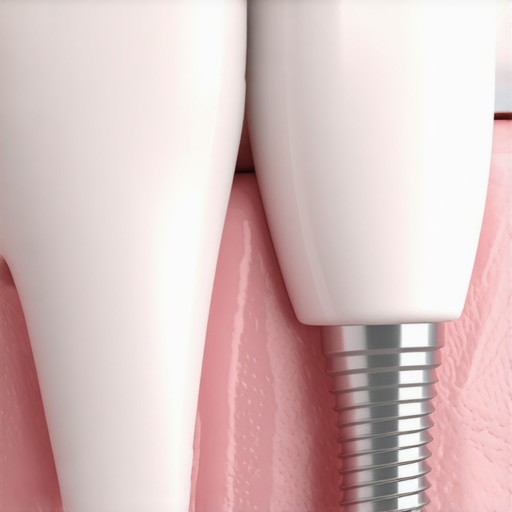
If your implant is completely healthy but your gums are simply naturally thin, the most straightforward solution is swapping out your metal abutment. Many older implants utilize dark titanium connectors. Today, cosmetic dentists frequently use custom zirconia abutments, which are tooth-colored or white. Even if your tissue thins out slightly over time, the material underneath matches your natural teeth, eliminating the dark shadow entirely.
Tissue Grafting to Rebuild Your Receding Gums
If you have experienced tissue loss, we can physically rebuild the gumline. During my treatment, my doctor performed a micro-surgical soft tissue graft. They gently took a tiny sliver of tissue from the roof of my mouth and placed it over the exposed metal area. It sounds intimidating, but with modern cutting-edge techniques in cosmetic dentistry, the recovery is incredibly fast. Once healed, this new tissue acting as a thicker barrier, completely covering the metal screw and reinforcing the area against future recession.
Upgrading to a Better Fitted Crown
Sometimes the angle of your original crown is the culprit behind the recession. In these cases, fabricating a new crown is the best approach. A cosmetic dentist can reshape the contours of the new porcelain crown to guide the gum tissue downward, naturally draping it over the exposed metal. It is a highly effective way to redesign your smile line, and is a common technique used when patients choose between veneers vs crowns to optimize their overall dental aesthetics.
How to Clean Your Teeth While Waiting for Your Appointment
While you wait to see your doctor, you must modify your home care routine immediately. If you keep scrubbing the metal with a stiff toothbrush, you will only push the gums back further. Switch to an extra-soft manual toothbrush or a sensitive brush head on your electric toothbrush. Hold the brush at a 45-degree angle and use gentle, sweeping motions away from the gumline rather than scrubbing back and forth. If you notice other issues, like gums receding despite perfect brushing, this soft approach will protect your remaining delicate tissue from further abrasion.
When we talk about restoring a smile, there is a massive misconception that often derails patients. Most people believe that cosmetic dentistry and restorative dentistry are two completely separate tracks. They assume that choosing veneers vs crowns or getting dental implants is purely about vanity, while basic family dentistry is about health. In my experience, this binary thinking is a major trap. Every successful cosmetic procedure must be built on a foundation of structural health, and conversely, every structural restoration should be approached with an artistic, cosmetic eye.
A common, advanced mistake patients make when they notice metal showing near their gums is rushing to find a quick aesthetic fix without diagnosing the underlying biomechanical issue. For example, simply covering an exposed metal collar with a wider crown without addressing thin tissue or bone loss is a recipe for catastrophic failure. According to a study published in the Journal of Periodontology, thin tissue biotypes are highly susceptible to progressive recession when subjected to improper crown margins. If you just slap a larger porcelain cap over the area, the bulkier crown will actually accelerate the gum recession, exposing even more metal within a year.
Why does my dental implant crown look so different from my natural tooth?
This is one of the most sophisticated questions patients ask once they start looking closely at their restoration. The answer lies in the fundamental difference in how your natural teeth and implants emerge from your jawbone. A natural tooth has a wider, more flared root system at the gumline, whereas an implant post is a uniform, narrow cylinder. This structural difference means your dentist must carefully sculpt the transitional porcelain to mimic a natural emergence profile. If you want to understand this transition better, check out this guide on why your dental implant crown is shaped differently than your natural tooth to learn how specialists design these contours.
Another dangerous myth is the belief that dental implants are ‘set it and forget it’ devices that cannot get diseased because titanium doesn’t decay. While it is true that you cannot get a cavity in an implant, the surrounding bone and gum tissue are still highly vulnerable to bacterial attack. Neglecting professional maintenance under the assumption that your artificial teeth are invincible often leads to silent bone loss around the post. Have you ever fallen into this trap or noticed a subtle change in your implant’s appearance over time? Let me know in the comments below.
Now that we have demystified why that tiny grey shadow appears and how specialists fix it, let us talk about the everyday reality of keeping your dental implants perfect for decades. We often invest thousands of dollars into high-end cosmetic dentistry, only to treat our daily home care like a basic chore. To protect your investment, you need to transition your mindset from general dental hygiene to specialized implant maintenance.
How do I maintain my dental implant over time?
Unlike natural teeth, which are suspended in the jawbone by a flexible periodontal ligament, implants are fused directly to your bone. This means they do not have the same natural shock-absorbers or blood supply to fight off localized infections. To maintain your implant over time, you must focus on preventing biofilm accumulation at the exact junction where the crown meets the gumline. Regular string floss is often too thin to clean these wider, customized implant contours effectively.
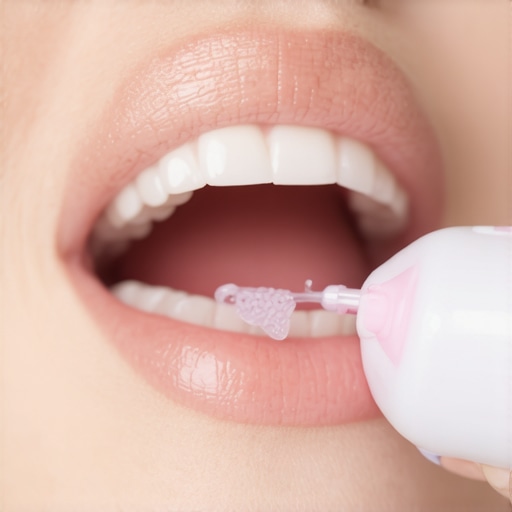
My absolute favorite tool for this job is a specialized proxy brush or thick, spongy floss. If you are struggling with tight spaces around your restorations, learning the trick to flossing around a bulky dental bridge or implant can save you from premature tissue recession. Additionally, I highly recommend using a high-quality oral irrigator (water flosser) on a medium setting. The pulsating water stream flushes out microscopic food particles from the deep sulcus around the titanium post that standard brushing simply cannot reach.
Looking ahead, the dental industry is moving rapidly toward smart biomaterials. According to clinical reports by Dr. Gordon Christensen of Clinicians Report, we are transitioning toward bioactive implant crowns and smart diagnostic mouthwashes that change color when they detect early-stage inflammatory proteins. In the near future, you won’t have to guess if there is hidden inflammation around your screw; your home care tools will alert you before any tissue recession even begins.
If you want to ensure your smile remains flawless, start today by swapping out your hard-bristled brush for an extra-soft microfiber option and commit to using a water flosser every night. If you are experiencing other structural issues or considering comprehensive cosmetic upgrades, check out our guide on veneers vs crowns to find the absolute best path forward for your unique anatomy.
I will never forget the moment I looked in my bathroom mirror, pulled back my upper lip to inspect what I thought was a stubborn piece of spinach, and felt my heart sink into my stomach. It wasn’t food. There, right at the margin of my gumline, was a tiny, unmistakable speck of dark, metallic grey. My dental implant screw was peeking through. Panic immediately set in. I kept thinking, Is my entire implant failing? Am I going to lose my front tooth?
If you are staring at a similar metallic glint in your mouth right now, please take a deep breath. You are not alone, and your smile is not ruined. Today, we are going to dive into exactly why this happens, when you need to call your dentist, and how we can get your smile looking seamless again using modern cosmetic dentistry solutions.
That Cold Panic When Metal Peeks Through Your Gums
When I first noticed that tiny speck of grey, my immediate reaction was to scrub it. I grabbed my toothbrush and brushed so hard my gums started bleeding. That was my first major mistake. I thought I could clean it away, but in reality, aggressive scrubbing only worsens the issue by wearing down the delicate tissue even further. If your tissue is thin, rough brushing accelerates recession, making more of the metal visible.
According to clinical studies on implantology, minor mucosal recession affects a surprising number of patients over time due to thin tissue biotypes or natural bone remodeling. It is a common physical progression, not a personal failure of hygiene. The metal you see is usually the implant abutment or the top of the fixture itself, becoming visible because the overlying pink tissue has thinned out or pulled back.
Is this showing screw actually a dental emergency?
Your mind might be racing with worst-case scenarios, but a visible screw is rarely an immediate emergency unless it is accompanied by severe pain, swelling, or a distinct wobbling sensation. If your implant feels rock solid, you have time to plan your next step. However, it is not something to ignore. Leaving the metal exposed to the bacteria in your mouth can eventually lead to peri-implantitis, a form of gum disease that attacks the bone supporting your implant.
We need to address this before it compromises the structural integrity of your implant. Fortunately, whether you need minor tissue grafting, a crown replacement, or a custom abutment, there are highly effective ways to restore both the health and aesthetics of your smile. Have you noticed a shadow or a bit of grey metal showing near your gumline recently? Let me know in the comments below, or reach out to a professional to check it out.
Your Step-by-Step Action Plan to Conceal and Correct Exposed Metal
When you see that grey speck, you cannot just wish it away. Your dental implant is essentially a three-part machine: the titanium post buried in your bone, the crown that looks like a tooth, and the connector abutment in the middle. Think of your gums like a protective turtleneck sweater. If the collar of that sweater stretches out or pulls down, the neck underneath becomes visible. To fix this, we have to either adjust the ‘collar’ or change the color of the ‘neck’.
When I panicked over my own gray spot, my dentist walked me through three distinct clinical options. The exact path forward depends entirely on whether your tissue is healthy but thin, or if you have actually lost supportive bone structure. Here is how modern dentistry solves the problem without starting over from scratch.
The Abutment Swap for Instant Aesthetic Relief
If your implant is completely healthy but your gums are simply naturally thin, the most straightforward solution is swapping out your metal abutment. Many older implants utilize dark titanium connectors. Today, cosmetic dentists frequently use custom zirconia abutments, which are tooth-colored or white. Even if your tissue thins out slightly over time, the material underneath matches your natural teeth, eliminating the dark shadow entirely.
Tissue Grafting to Rebuild Your Receding Gums
If you have experienced tissue loss, we can physically rebuild the gumline. During my treatment, my doctor performed a micro-surgical soft tissue graft. They gently took a tiny sliver of tissue from the roof of my mouth and placed it over the exposed metal area. It sounds intimidating, but with modern cutting-edge techniques in cosmetic dentistry, the recovery is incredibly fast. Once healed, this new tissue acting as a thicker barrier, completely covering the metal screw and reinforcing the area against future recession.
Upgrading to a Better Fitted Crown
Sometimes the angle of your original crown is the culprit behind the recession. In these cases, fabricating a new crown is the best approach. A cosmetic dentist can reshape the contours of the new porcelain crown to guide the gum tissue downward, naturally draping it over the exposed metal. It is a highly effective way to redesign your smile line, and is a common technique used when patients choose between veneers vs crowns to optimize their overall dental aesthetics.
How to Clean Your Teeth While Waiting for Your Appointment
While you wait to see your doctor, you must modify your home care routine immediately. If you keep scrubbing the metal with a stiff toothbrush, you will only push the gums back further. Switch to an extra-soft manual toothbrush or a sensitive brush head on your electric toothbrush. Hold the brush at a 45-degree angle and use gentle, sweeping motions away from the gumline rather than scrubbing back and forth. If you notice other issues, like gums receding despite perfect brushing, this soft approach will protect your remaining delicate tissue from further abrasion.
When we talk about restoring a smile, there is a massive misconception that often derails patients. Most people believe that cosmetic dentistry and restorative dentistry are two completely separate tracks. They assume that choosing veneers vs crowns or getting dental implants is purely about vanity, while basic family dentistry is about health. In my experience, this binary thinking is a major trap. Every successful cosmetic procedure must be built on a foundation of structural health, and conversely, every structural restoration should be approached with an artistic, cosmetic eye.
A common, advanced mistake patients make when they notice metal showing near their gums is rushing to find a quick aesthetic fix without diagnosing the underlying biomechanical issue. For example, simply covering an exposed metal collar with a wider crown without addressing thin tissue or bone loss is a recipe for catastrophic failure. According to a study published in the Journal of Periodontology, thin tissue biotypes are highly susceptible to progressive recession when subjected to improper crown margins. If you just slap a larger porcelain cap over the area, the bulkier crown will actually accelerate the gum recession, exposing even more metal within a year.
Why does my dental implant crown look so different from my natural tooth?
This is one of the most sophisticated questions patients ask once they start looking closely at their restoration. The answer lies in the fundamental difference in how your natural teeth and implants emerge from your jawbone. A natural tooth has a wider, more flared root system at the gumline, whereas an implant post is a uniform, narrow cylinder. This structural difference means your dentist must carefully sculpt the transitional porcelain to mimic a natural emergence profile. If you want to understand this transition better, check out this guide on why your dental implant crown is shaped differently than your natural tooth to learn how specialists design these contours.
Another dangerous myth is the belief that dental implants are ‘set it and forget it’ devices that cannot get diseased because titanium doesn’t decay. While it is true that you cannot get a cavity in an implant, the surrounding bone and gum tissue are still highly vulnerable to bacterial attack. Neglecting professional maintenance under the assumption that your artificial teeth are invincible often leads to silent bone loss around the post. Have you ever fallen into this trap or noticed a subtle change in your implant’s appearance over time? Let me know in the comments below.
Now that we have demystified why that tiny grey shadow appears and how specialists fix it, let us talk about the everyday reality of keeping your dental implants perfect for decades. We often invest thousands of dollars into high-end cosmetic dentistry, only to treat our daily home care like a basic chore. To protect your investment, you need to transition your mindset from general dental hygiene to specialized implant maintenance.
How do I maintain my dental implant over time?
Unlike natural teeth, which are suspended in the jawbone by a flexible periodontal ligament, implants are fused directly to your bone. This means they do not have the same natural shock-absorbers or blood supply to fight off localized infections. To maintain your implant over time, you must focus on preventing biofilm accumulation at the exact junction where the crown meets the gumline. Regular string floss is often too thin to clean these wider, customized implant contours effectively.
My absolute favorite tool for this job is a specialized proxy brush or thick, spongy floss. If you are struggling with tight spaces around your restorations, learning the trick to flossing around a bulky dental bridge or implant can save you from premature tissue recession. Additionally, I highly recommend using a high-quality oral irrigator (water flosser) on a medium setting. The pulsating water stream flushes out microscopic food particles from the deep sulcus around the titanium post that standard brushing simply cannot reach.
Looking ahead, the dental industry is moving rapidly toward smart biomaterials. According to clinical reports by Dr. Gordon Christensen of Clinicians Report, we are transitioning toward bioactive implant crowns and smart diagnostic mouthwashes that change color when they detect early-stage inflammatory proteins. In the near future, you won’t have to guess if there is hidden inflammation around your screw; your home care tools will alert you before any tissue recession even begins.
If you want to ensure your smile remains flawless, start today by swapping out your hard-bristled brush for an extra-soft microfiber option and commit to using a water flosser every night. If you are experiencing other structural issues or considering comprehensive cosmetic upgrades, check out our guide on veneers vs crowns to find the absolute best path forward for your unique anatomy.
The Hardest Lessons My Exposed Screw Taught Me About Dental Work
Going through the emotional rollercoaster of a visible implant screw shifted my entire perspective on restorative dentistry. Here are the unexpected realizations that saved my smile, and can save yours too:
- The illusion of invincibility is dangerous: Just because your titanium implant cannot get a cavity doesn’t mean you can slack off on your hygiene; the bone keeping it in place is very much alive and vulnerable.
- Gums require gentle respect, not aggressive scrubbing: Pushing your gum tissue back through rough brushing is incredibly easy to do but incredibly complex and expensive to reverse.
- Cosmetics and structure are inseparable: You cannot expect a gorgeous smile if you ignore the biological foundation underneath your prosthetics.
My Essential Toolkit for Protecting Premium Restorations
If you want to prolong the life of your cosmetic dental work, you have to upgrade your home care tools. Here is the exact lineup I personally use and trust:
- Ultra-soft tapered micro-bristle toothbrushes: These protect delicate gums while gently sweeping debris away from the implant collar.
- Pulsating oral irrigators with specialized tips: Crucial for flushing out bacteria from deep periodontal pockets without causing tissue abrasion.
- Spongy thick dental floss: This expands slightly around bulky custom crowns, ensuring the hidden sides of the implant stay immaculate.
Take Back Control of Your Smile
Seeing metal peek through your gumline can be deeply unsettling, but modern how dental implants reshape your oral health in 2025 proofed techniques mean you have more power than ever to correct the issue. By acting quickly and consulting with a skilled cosmetic specialist, you can protect both your oral health and your confidence. Do not let fear keep you from smiling freely. Have you ever noticed an unexpected dark shadow or felt a change in your dental implant? Let me know your experience in the comments below!